Gathering
Drawing up a long edge to fit a shorter one with soft, even fullness - how much fabric to allow, where to put the gathering rows, the cord method for long or heavy edges, and fixes for snapped threads.
Published · Updated

Gathering spreads fullness evenly along an edge instead of concentrating it at one point the way a dart does. You sew long, loose rows of stitching along the edge, pull up the threads until the fabric bunches to the length you need, and sew it to a shorter piece: a waistband, a bodice, a cuff or a yoke. Dirndl skirts, puffed sleeves, ruffles, tiered dresses and smocks are all built on it.
It's a beginner technique, but there is a real difference between gathers that look even and deliberate and gathers that bunch in one place and go flat in another. Nearly all of that difference comes from three habits: allowing the right amount of fabric, dividing the edge into sections, and sewing the seam with the gathers facing up.
How much fabric to gather
The gathering ratio is the length of the edge before gathering compared to the length it's gathered down to.
| Ratio | Effect | Works well in |
|---|---|---|
| 1.25-1.5 × | Gentle easing, barely visible gathers | Heavier cottons, linen, wool, corduroy |
| 2 × | Classic, clearly gathered | Most cottons, lawn, poplin, rayon |
| 2.5-3 × | Very full, frothy | Chiffon, georgette, voile, tulle, ruffles |
So a skirt gathered into a 28" (71 cm) waistband at 2× needs a rectangle 56" (142 cm) around. Lighter fabrics need more fullness to look gathered at all, while heavier fabrics get bulky very quickly. When I'm unsure, I gather a 10" (25 cm) test strip to two or three different lengths and pin each to a piece of card to compare.
Setting up the machine
- Stitch length: the longest straight stitch the machine has, usually 4-5 mm. Longer stitches gather more easily and more evenly.
- Upper tension: loosen it slightly (by one or two numbers). You'll be pulling the bobbin threads, and lower tension lets them slide.
- Thread: a good all-purpose polyester in the bobbin is less likely to snap than cotton.
- Leave long tails, at least 4" (10 cm), at both ends of every row, and don't backstitch.
Where to put the rows
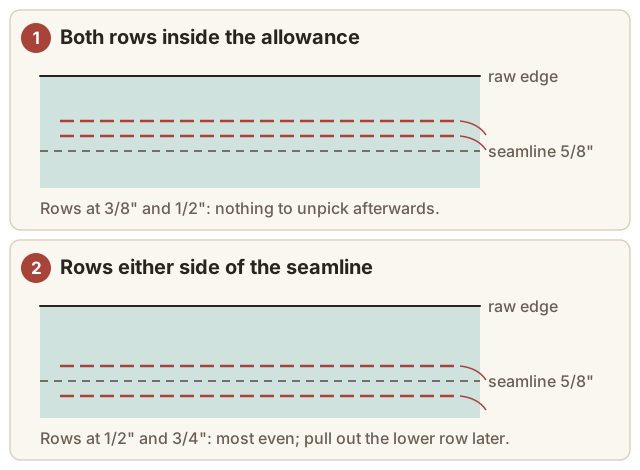
Use two rows, not one. Two rows pulled together keep the folds of fabric standing straight up and evenly spaced. A single row lets them twist and lean. There are two good layouts:
- Both rows inside the seam allowance, for example at 3/8" and 1/2" (1 cm and 1.3 cm) on a 5/8" (1.5 cm) allowance. When you sew the seam at 5/8", both rows are hidden in the allowance and nothing has to be removed. This is the quickest option and fine for most garments.
- Rows either side of the seamline, at 1/2" and 3/4" (1.3 cm and 2 cm). You sew the seam between them, which holds the gathers firmly on both sides of the stitching and gives the most even result. The lower row shows on the right side afterwards, so pull it out once the seam is sewn.
For heavy fabrics or very long edges, add a third row. For a long skirt edge, break the rows into sections, such as front and back separately, so that if a thread snaps you only lose a section, not the whole length.
Gathering and sewing the seam
- Mark matching points. Fold the gathered piece into quarters (or eighths for a long edge) and mark each fold with a snip or pin in the seam allowance. Do the same on the edge it will be sewn to. This one step does more for even gathers than anything else.
- Anchor one end. Wrap the thread tails at one end around a pin in a figure eight so they can't pull out.
- Pull the bobbin threads from the other end, both together, and slide the fabric along the threads in small sections. Don't try to push the whole length at once.
- Pin to the matching points. With right sides together, pin the gathered piece to its partner at each mark, then pull up the gathers within each section until it fits. Even out the fullness with your fingers and pin generously, every inch or so.
- Sew with the gathered side up. That way you can see the folds as they approach the needle and stop small pleats forming and being stitched in. Sew slowly, smoothing each section flat just in front of the foot.
- Remove any visible gathering rows and finish the seam allowances together. An overlock or zigzag works well. For a really clean inside, enclose them in a strip of bias binding.
- Press the seam allowance toward the flat piece, the waistband or bodice, not into the gathers. Then press into the gathers from the right side using only the tip of the iron. Never press gathers flat.
The cord method for long or heavy edges
For ruffles several metres long, or for denim, corduroy and wool, threads snap long before the fabric is fully gathered. Instead, lay a strong cord along the edge inside the seam allowance: crochet cotton, buttonhole twist, or plain unwaxed dental floss. Zigzag over it without catching it, using a stitch wide enough to straddle the cord. Anchor one end and pull the cord rather than the thread. The fabric slides along it easily, nothing breaks, and you pull the cord out once the seam is sewn.
On an overlocker, setting the differential feed to its highest value gathers lightweight fabric automatically as it's serged. It's useful for ruffles, though harder to control to an exact length.
Troubleshooting
The thread snaps halfway. Pull out the broken row, re-sew it in shorter sections, or switch to the cord method. Make sure the top tension is loosened slightly.
The gathers are bunched in some places and flat in others. Mark quarter points and redistribute. Gathers left to themselves migrate toward the end you pull from.
Little pleats sewn into the seam. The seam was sewn with the gathered side underneath, or the fabric wasn't smoothed in front of the foot. Unpick the section, redistribute, and resew it gathered side up.
The seam is too bulky. Grade the allowances, trimming the gathered layer narrower than the flat one, and finish them together. Heavy fabrics can be gathered at a lower ratio or replaced with pleats, which control the fullness more neatly.