Draping vs. Flat Pattern
The two ways to make a pattern - sculpting fabric on a dress form, or drafting with measurements and rulers on paper - how each works, what each is good at, and how they combine in practice.
Published · Updated

Every pattern starts in one of two ways. Flat pattern drafting starts on paper: body measurements go into a set of drafting instructions, or onto an existing block, and the pattern is built with rulers, curves and calculation. Draping starts on a dress form: you pin fabric, usually muslin, directly onto the form, mould it into the shape you want, mark where the seams and darts fall, and then transfer that shape to paper.
They aren't rival schools so much as two tools. Professional patternmakers use both, often on the same garment. Knowing what each is good at saves a lot of time.
How each workflow runs
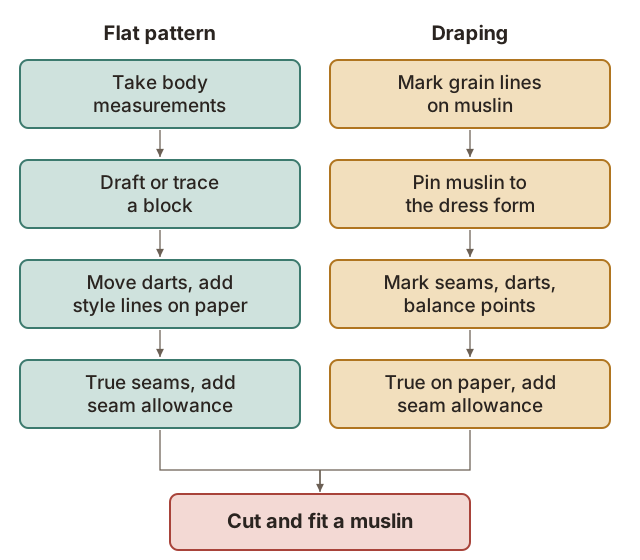
Flat pattern. You take measurements and draft a block, a basic fitted pattern with no style features, using a drafting system. Or you start from a block you already have. You then trace the block and change it on paper: moving darts, adding fullness by slashing and spreading, drawing new necklines and seam lines. When the design is done, you true the pattern (check that seams that will be sewn together are the same length and meet smoothly), add seam allowances and notches, and cut a test version. The Basic Bodice Block and A-Line Skirt pages show flat pattern methods in action.
Draping. You prepare a piece of muslin slightly larger than the area to be draped, and draw the lengthwise and crosswise grain lines on it. You pin it to the form, matching the lengthwise grain to centre front or centre back and keeping the crosswise grain level at the bust or hip line. You then smooth and pin the fabric over the form, folding out darts, pinning seams, and cutting away excess as you go. Once the shape is right, you mark every seamline, dart, and balance point (where seams should match) with pencil while it's still on the form. Then you unpin it, lay it flat, true the lines on paper with rulers and curves, and add seam allowances.
What each is good at
| Flat pattern | Draping | |
|---|---|---|
| Best for | Structured, symmetrical garments: tailored bodices, shirts, straight and A-line skirts, trousers | Soft, asymmetric or sculptural designs: cowls, wrapped and twisted bodices, bias-cut gowns |
| Strengths | Precise, repeatable, easy to grade into other sizes, needs little equipment | You see the design in three dimensions as you make it; the fabric's drape becomes part of the design |
| Weaknesses | Hard to visualise unusual shapes; drafts can look right on paper and wrong on a body | Only as accurate as the dress form; harder to repeat exactly; needs practice to keep grain straight |
| Equipment | Pattern paper, long ruler, set square, French curve, hip curve, tracing wheel, pencil | Dress form padded to your measurements, muslin, pins, style tape, pencil, shears |
Choosing between them
I use flat pattern work for anything with a defined structure, where precision and symmetry matter and the shape can be described by measurements. A shirt with a yoke, a fitted bodice, a skirt with an exact flare: these are faster and more reliable on paper.
I use draping when I can't picture the shape well enough to draft it, or when the way the fabric falls is the design. A cowl neckline is the standard example. On paper it's an awkward slash-and-spread exercise. On a form you simply let the fabric fall into folds and pin it where it looks right. Madeleine Vionnet, whose 1920s and 1930s bias-cut gowns are still studied by patternmakers, worked almost entirely by draping on a small-scale mannequin. The fluid, body-skimming shapes she made depend on how bias-cut fabric behaves, and that is far easier to see than to calculate (see The 1930s Bias-Cut Silhouette).
In practice most patterns are hybrids. A designer might drape the bodice of a dress to get a draped neckline right, then flat-draft the skirt from a block, then true the whole thing on paper.
The dress form matters more than people expect
Draping is only as accurate as the form underneath it. A standard dress form in your nominal size will not match your body: shoulder slope, bust position, back curve and hip shape all vary. For draping clothes for yourself, pad a form slightly smaller than you to your measurements and shape, using quilt batting and a fitted cover made from your own bodice block. Then mark the form with style tape at centre front, centre back, bust line, waist line, hip line and side seams, so you have reference lines to drape against.
Keeping grain under control when draping
Most beginner draping problems come from grain drifting. Draw grain lines on the muslin before you start, pin the lengthwise grain to the form first, and check the crosswise grain stays level as you work outward. If the crosswise line starts dipping or rising, the fabric is being pulled off-grain and the finished garment will twist or hang unevenly.
Where to start learning
If you're new to both, start with flat pattern. Drafting your own skirt block and bodice block teaches the relationship between measurements, ease and shape, and that understanding makes draping far easier to learn later. Draping a simple bodice block on a form and comparing it with your drafted one is a revealing exercise: you see exactly where the drafting system's assumptions differ from your shape.
Further reading
- Helen Joseph-Armstrong, Patternmaking for Fashion Design (flat pattern, comprehensive)
- Winifred Aldrich, Metric Pattern Cutting for Women's Wear (flat pattern, metric blocks)
- Helen Joseph-Armstrong, Draping for Apparel Design (draping from basics to advanced)