Grainline
Published · Updated

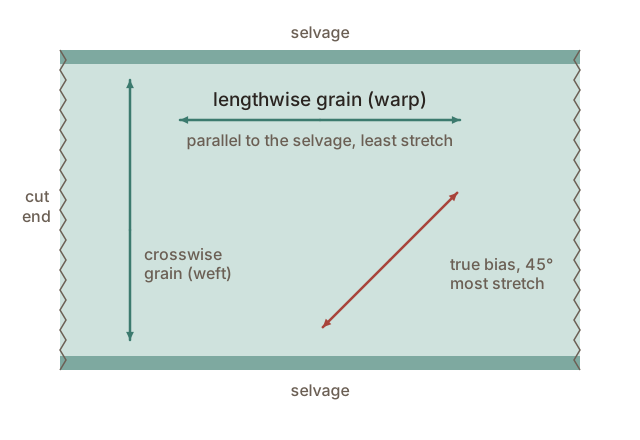
Grain is the direction of the threads in a woven fabric. The lengthwise grain follows the warp threads, which run the length of the fabric parallel to the selvage. The crosswise grain follows the weft threads, which run across from selvage to selvage. Together they're called the straight grain. Anything at an angle to them is off-grain, and the 45-degree diagonal is the bias.
On a pattern piece, the grainline is the long arrow printed on it, usually with arrowheads at both ends. It shows which way the piece should sit on the fabric. Laying that arrow exactly parallel to the lengthwise grain is one of the few layout steps that can't be corrected later.
Why it matters
The lengthwise grain is the most stable direction of a woven fabric. The warp threads are held under tension on the loom and are usually stronger and more tightly set. Patterns are designed with that in mind: a skirt or trouser leg cut with the lengthwise grain running vertically hangs straight down, because gravity pulls along the strongest threads.
Cut the same piece a few degrees off-grain and gravity pulls at an angle to the threads instead. The garment twists, side seams swing toward the front or back, trouser legs spiral around the leg, and hems hang unevenly. No amount of pressing fixes it, because the cause is in the cut.
Laying out a pattern on grain
- Fold the fabric selvage to selvage (unless the layout says otherwise) and smooth it so the selvages line up and the fold has no ripples.
- Place each piece roughly in position, with its grainline arrow running in the same direction as the selvage.
- Measure from one end of the arrow to the selvage (or to the fold) with a ruler or tape measure, and pin that end.
- Measure from the other end of the arrow and shift the piece until the distance is exactly the same. Pin.
- Pin the rest of the piece, smoothing outward from the grainline.
For pieces marked "place on fold", the fold itself is the grainline: the fold must run exactly along the lengthwise grain.
Straightening off-grain fabric
Fabric is sometimes pulled off-grain during finishing, so the crosswise threads aren't at right angles to the selvage. To check:
- Straighten one cut end, either by tearing across (on firm cottons that tear cleanly) or by pulling a crosswise thread and cutting along the line it leaves.
- Fold the fabric selvage to selvage. If the straightened ends don't line up, or the fabric won't lie flat, it's off-grain.
- Pull the fabric firmly on the bias in the direction of the shorter corner, a section at a time, and press. On many cottons, linens and wools this brings it back into square.
Some fabrics can't be straightened: polyesters and blends with a heat-set finish, and many printed fabrics where the print was applied slightly off-grain. For prints, decide whether the grain or the print matters more. Usually the grain wins for anything fitted, though a visibly crooked stripe is hard to live with.
Knits and the grainline
Knits have no warp or weft, but they do have a direction. The lengthwise ribs (wales) run down the fabric, and the grainline on a knit pattern is placed parallel to them. Most knits stretch most across the width, so cutting along the ribs puts the stretch around the body, where the pattern expects it. See Knit Fabrics.
Intentionally off-grain
The exceptions are pieces cut on the bias on purpose (bias-cut skirts, binding, cowls) and pieces deliberately turned for effect, such as a plaid yoke cut diagonally. In those cases the pattern's grainline arrow is drawn at the angle needed. You still line the arrow up with the lengthwise grain, and the piece ends up at the right angle automatically.