Knit Fabrics
How knits differ from wovens, the main types (jersey, rib, interlock, ponte, French terry, sweatshirt fleece), measuring stretch percentage, and the needles, stitches and seams that keep knit garments from popping.
Published · Updated

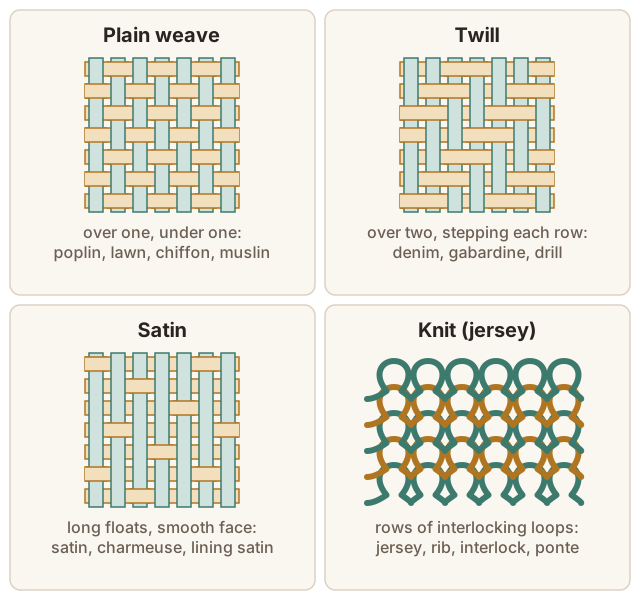
Woven fabric is made of two sets of threads crossing at right angles. Knit fabric is made from one yarn (or a few) formed into rows of interlocking loops, the same structure as hand knitting, made by machine. The loops can stretch, flatten and recover, so knits stretch without needing elastane, and they drape, cling and move with the body in a way most wovens can't. T-shirts, leggings, sweatshirts, swimwear, underwear and most activewear are knits.
What changes when you sew knits
- Patterns are drafted differently. Many knit patterns have no darts or closures, because the stretch does the shaping, and they often have zero or negative ease. A pattern drafted for a knit won't work in a woven, and usually not in a knit with much less stretch than specified.
- Seams have to stretch. A straight stitch has no give, so in a knit seam that's stretched in wear (side seams, necklines, waistbands) it snaps. Knit seams use stretch stitches, zigzag, or an overlocker.
- The needle must not pierce the loops. A sharp needle can cut the yarn and start a run or a hole. Knits need ballpoint (jersey) or stretch needles.
- Edges don't fray, but they may curl. Knit edges don't unravel the way woven edges do, so seam finishing is often optional. Jersey edges curl, which can make cutting and sewing fiddly.
The main types
- Single jersey (T-shirt knit): smooth V-shaped columns on the face, loops on the back. Light, drapey, curls at the edges. Cotton jersey has modest stretch. Rayon/viscose and modal jersey are fluid and drapey.
- Rib knit: pronounced vertical ribs, very stretchy across the width with excellent recovery. Used for neckbands, cuffs, waistbands and fitted tops.
- Interlock: a double knit that looks like jersey on both sides. Smooth, stable, doesn't curl. Used for T-shirts and children's clothes.
- Ponte (ponte di Roma): a thick, firm double knit with moderate stretch. It behaves almost like a woven when cutting and sewing, which makes it the easiest knit to start with. Used for dresses, skirts and trousers.
- French terry: smooth on the face, small loops on the back. Used for sweatshirts and loungewear.
- Sweatshirt fleece: brushed on the back for warmth.
- Stretch knits with elastane (spandex, Lycra): swimwear, activewear and leggings fabric, with high stretch and strong recovery. See Synthetic Fibers.
Measuring stretch
Knit patterns state how much stretch the fabric needs, usually as a percentage. To measure it:
- Fold the fabric along the crosswise direction, a few inches in from the cut edge.
- Mark 4" (10 cm) along the fold.
- Hold one mark still and stretch the fabric gently along a ruler until it starts to resist or distort. Don't force it.
- Read where the second mark ends up. If 4" stretches to 5", that's 25% stretch; to 6" is 50%; to 8" is 100%.
Then let it go and check recovery: does it spring back to 4", or stay baggy? Good recovery matters as much as stretch, especially for waistbands, cuffs and leggings. Some knits stretch only across the width (two-way stretch). Others stretch in both directions (four-way stretch), which you need for swimwear and leggings.
Cutting knits
- Lay it flat and relaxed. Don't let it hang off the table, which stretches it. Let it rest for a while after unrolling.
- Find the lengthwise grain by following a vertical rib or column of loops, not the cut edge, which is rarely straight. Place the pattern grainline parallel to it.
- Use pattern weights and a rotary cutter if possible. Pins and shears both distort knits more than wovens.
- Pre-wash first. Cotton and rayon knits can shrink a lot, sometimes more in length than width.
Sewing knits
Needles: ballpoint/jersey (70/10-90/14) for cotton, rayon and most knits. Stretch needles (75/11-90/14) for spandex blends, swimwear and anything where stitches skip.
On a sewing machine:
- A narrow zigzag (about 0.5-1 mm wide, 2.5 mm long) looks almost like a straight stitch but stretches.
- A stretch or "lightning bolt" stitch, if your machine has one, for seams.
- A twin needle for hems: two parallel rows on top and a zigzag underneath, which stretches. Lengthen the stitch to about 3 mm.
- A walking foot helps stop layers stretching unevenly as they feed.
On an overlocker: a 4-thread overlock stitch sews and finishes a knit seam in one pass with plenty of stretch. It's how most ready-to-wear knits are made. Use the differential feed to prevent wavy seams. See Serger / Overlocker.
Stabilise where it shouldn't stretch. Shoulder seams and sometimes waistlines are stabilised with clear elastic or a strip of stay tape, so they don't grow with wear.
Neckbands are cut shorter than the neckline, typically around 85-90% of its length depending on the fabric's stretch, and stretched to fit as you sew, so they lie flat against the body.
Pressing
Press knits rather than ironing them, because sliding the iron stretches them. Use a temperature suited to the fibre: cotton tolerates heat, but polyester and spandex blends need a low setting. Use plenty of steam to coax out ripples, and let the fabric cool before moving it.
Troubleshooting
- Wavy, stretched-out seams or hems: the fabric stretched while feeding. Use a walking foot, reduce presser foot pressure, increase the differential feed on an overlocker, or lengthen the stitch.
- Skipped stitches: switch to a stretch needle.
- Holes along the seam after wear: the needle damaged the loops. Use a fresh ballpoint needle.
- Popped seams: the stitch doesn't stretch enough. Use a zigzag, stretch stitch, or overlock.