Grading
Published · Updated

Grading a seam means trimming each layer of the seam allowance to a different width, so the layers step down one after another instead of all ending at the same point. When three or four layers of allowance (fabric, facing, interfacing) are trimmed to the same width, their edges stack into a single hard ridge that shows through on the right side as a line or a bump after pressing. Staggered edges spread that thickness out, so the seam tapers and lies flat.
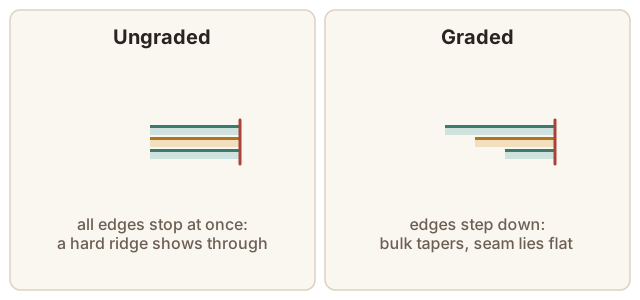
Which layer is cut narrowest
The general rule: the layer that will end up closest to the outside of the garment is left widest, so it cushions the shorter layers beneath it and their edges can't print through. The layer closest to the body is trimmed narrowest.
On a collar, for example, the upper collar's allowance is left at about 1/4" (6 mm) and the under collar's is trimmed to about 1/8" (3 mm). On a faced neckline, the garment's allowance (which lies against the outer garment) stays wider and the facing's allowance is trimmed narrower. If interfacing is included in the seam, it's usually trimmed close to the stitching, or cut out of the seam allowance entirely before sewing.
Where to grade
Grading pays off wherever several layers are enclosed together and pressed to one side:
- Collars, cuffs and lapels.
- Faced necklines and armholes.
- Waistbands.
- Enclosed seams on bags and linings.
- Curved seams that will be turned through.
Grading isn't needed on an ordinary seam that's pressed open or finished with an overlocker. Don't grade a seam you might need to let out later, because trimmed allowances can't be recovered.
Grading with other trimming
Grading usually happens alongside other steps that reduce bulk in enclosed seams:
- Trim corners diagonally, close to the stitching, at collar points and square necklines.
- Clip inward curves, such as a neckline: short cuts into the allowance almost to the stitching, so it can spread when turned.
- Notch outward curves, such as a rounded collar edge: cut small wedges out of the allowance so it doesn't overlap itself when turned.
- Grade the remaining layers to stepped widths.
- Understitch if the seam should roll to the inside. See Collar.
Use small, sharp scissors and hold them at a slight angle (bevelled), which thins the edge further. Some sewists grade by holding the scissors flat at an angle to all the layers at once, which grades them in one cut.
Grading in pattern making
The same word means something completely different in pattern making. Pattern grading is the process of scaling a pattern up and down to make a range of sizes, by moving key points of the pattern by set amounts for each size. Sized, graded paper patterns sold to home sewists are associated with Ebenezer and Ellen Butterick, who began selling them in 1863 (see Notable Figures). When a pattern instruction tells you to "grade the seam allowances", it always means trimming. When people talk about "grading between sizes", they mean blending from one size's cutting line to another's.